Africa

This website has been archived and is no longer maintained.

This website has been archived and is no longer maintained. Older content or site functionality may not be accessible or functional in newer browsers. If you require accessible documents, please contact the Department of Plant Sciences for further information.

Horticulture Innovation Lab in Africa
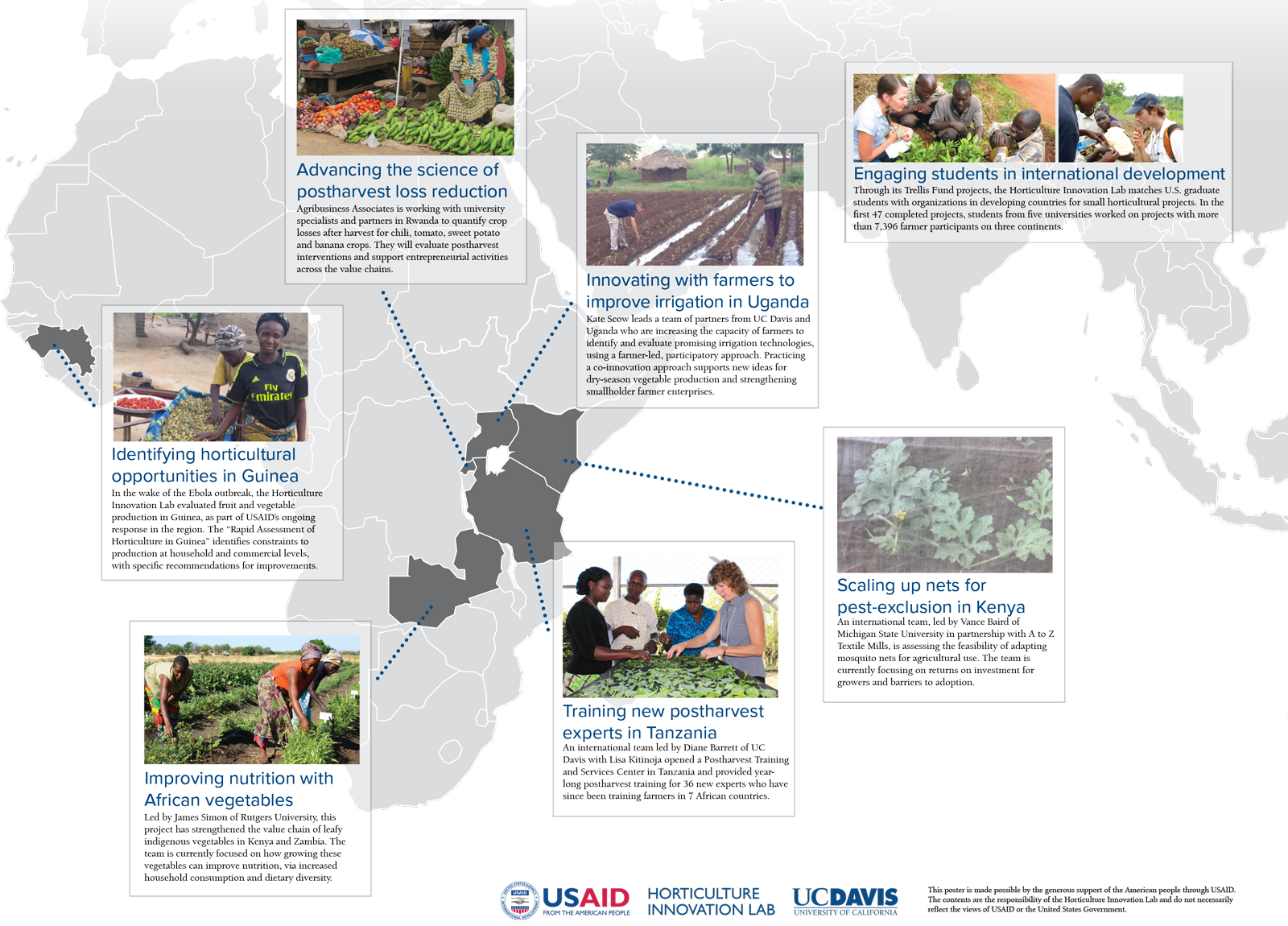
Africa map with Horticulture Innovation Lab project highlights - Advancing the science of postharvest loss reduction, Innovating with farmers to improve irrigation in Uganda, Scaling up nets for pest-exclusion in Kenya, Training new postharvest experts in Tanzania, Improving nutrition with African vegetables, Identifying horticultural opportunities in Guinea
Select Horticulture Innovation Lab projects in Africa, from a poster displayed at a conference focused on United Nations Sustainable Development Goals (SDGs) held at UC Davis in 2017.

The Horticulture Innovation Lab has research teams working in several African countries to advance horticultural science in relation to nutritious vegetables, reducing postharvest losses, improving fruit and vegetable production, helping smallholder farmers access appropriate irrigation solutions and other research topics related to fruit and vegetable production.

More information about the Horticulture Innovation Lab's projects are available in fact sheets focused on the program's activities and research investments in three African regions:

One of the program's major projects is focused on improving nutrition with African indigenous vegetables in Kenya and Zambia. This five-year project incorporates team members and lessons learned from previous projects in Kenya, Tanzania and Zambia that focused on various aspects of the value chain for African indigenous vegetables.

Another major project is focused on reducing postharvest losses in Rwanda, which takes a systematic approach to the complex challenges and business opportunities inherent in postharvest stages of horticultural crops. The research project includes evaluations of postharvest losses across four different value chains, establishing postharvest training and service centers (PTSCs) in three locations, and building entrepreneurial capacity for stakeholders to capture value while reducing losses.

In 2015 during the wake of the Ebola outbreak, the Horticulture Innovation Lab was contracted to conduct a "Rapid Assessment of the Horticulture Sector in Guinea," as part of USAID's long-term response to the region. After the report, the program also began work in Guinea to establish a youth-led Horticulture Training and Service Center to share horticultural innovations with the region while engaging local youth in profitable endeavors. 
 

Richard Adu Amoah

Dr. Richard Adu Amoah is a Plant Breeder with Council for Scientific and Industrial Research – Plant Genetic Resources Institute (CSIR-PGRRI) who has expertise in crop germplasm collection, assessment of plant genetic diversity as well as application of conventional breeding techniques and advanced molecular tools to improve the performance and productivity of crops.

Joris Gerald Niilante Amissah

Dr. Joris Gerald Niilante Amissah is a Senior Lecturer in the Department of Family and Consumer Sciences at the University of Ghana. He holds a PhD and an MS in Food Science from Cornell University and a BSc. in Biochemistry from the University of Science and Technology (Kumasi, Ghana).

Fassé Samaké

  • Co-PI
Professor Fassé Samaké is a Professor in Microbiology and Microbial Ecology, and the Head of the Cooperation Department of the University of Sciences, Techniques and Technologies of Bamako, Mali. 

Charles Tortoe

Charles Tortoe is an Associate Professor of the CSIR-College of Science and Technology affiliated with the University of Cape Coast, Cape Coast, Ghana. He is a Director and Chief Research Scientist of the Council for Scientific and Industrial Research-Food Research Institute. He completed his Ph.D in Food Science and Technology at the University of Greenwich, United Kingdom, and obtained his BSc with honors and MPhil Botany in Microbiology, from the University of Ghana, Legon.